
Research partnership explores how AI can support older adults with autism and intellectual and developmental disabilities.
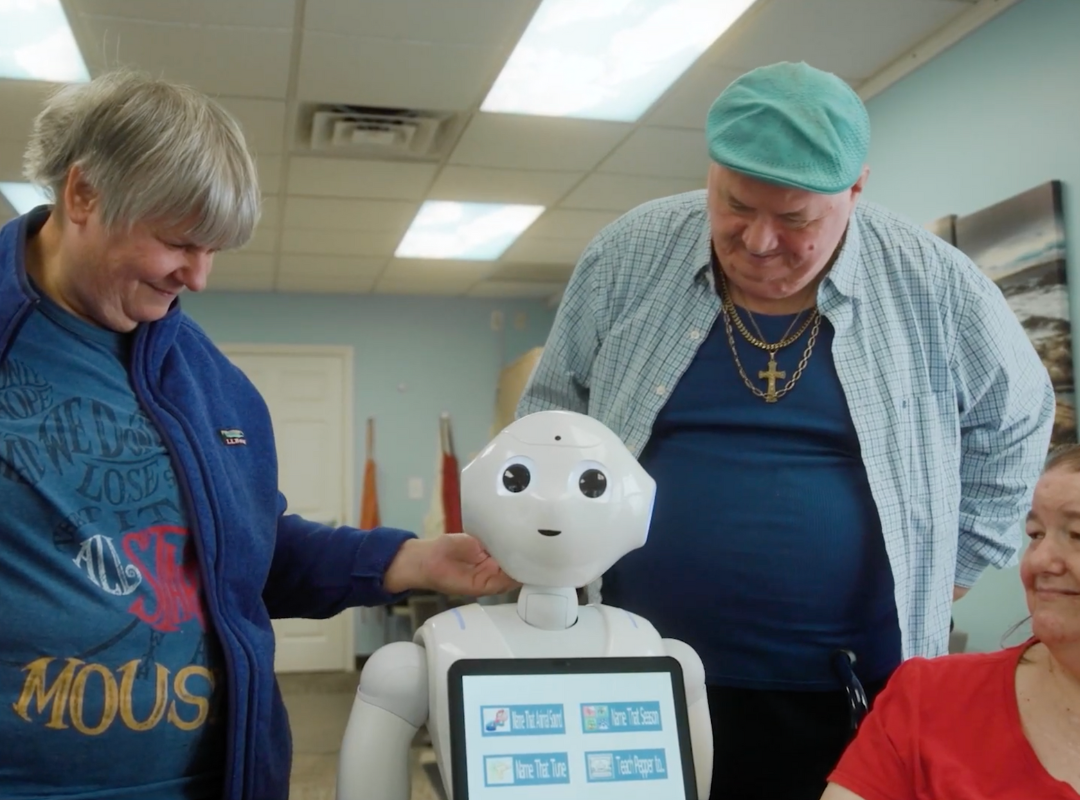
After months of collaboration and anticipation, Pepper, a humanoid AI robot, has officially joined the Bancroft team. Her new home is at the Judith B. Flicker Residences, a program that supports aging adults with autism and other intellectual and developmental disabilities (I/DD).
Pepper’s arrival marks a major milestone in an innovative research partnership between Bancroft and Saint Joseph’s University Haub Innovation Center exploring how artificial intelligence can enhance care, connection, and well-being for adults with autism as they age.
Where Research Meets Everyday Life
The research began more than a year ago with regular trips to Saint Joseph’s University, where Bancroft residents interacted with a Pepper robot on campus. These early interactions helped the research team begin exploring how this kind of technology could complement traditional supports, foster engagement, and inform more personalized models of care.
With Pepper now living on-site at Bancroft, those interactions are no longer limited to scheduled visits. They’re part of everyday life, and that shift is helping move the research deeper and faster.
“Technology can never replace human connection, but it can help us think differently about how we support people as they age,” said Dr. Karen Lindgren, Chief Clinical Officer at Bancroft. “This partnership is a beautiful example of what happens when academic research and real-world experience come together with a shared purpose. We’re all learning from each other and, most importantly, we’re learning from the people we support.”
Shining a Light on Autism and Aging
While most autism research focuses on children, this project addresses a critical and often overlooked question: what does aging look like for adults with autism and I/DD and how can we best support them through it?
Aging can bring physical, emotional, and cognitive changes for everyone. But for people with autism and I/DD, some of those changes, particularly cognitive decline, can be especially hard to detect. Subtle shifts in behavior or communication may go unnoticed or be difficult to interpret, even for seasoned clinicians. That’s one of the key areas researchers are exploring with Pepper.
Exploring Pepper’s Potential
Pepper can recognize faces and voices, hold conversations, lead mindfulness activities, play games, and more. But beyond those day-to-day interactions, researchers are especially interested in her potential to observe subtle changes over time.
As she becomes more familiar with each resident, Pepper may begin to detect small shifts in speech, movement, or mood — patterns that could signal early signs of cognitive decline. This insight could provide clinicians with an added layer of understanding, especially for individuals who may have difficulty communicating how they’re feeling. One day, that information might even be shared directly with healthcare providers to help guide care.
It’s a collaborative learning process. Pepper is learning from the residents. The researchers and clinicians are learning from Pepper. And together, they’re uncovering new ways to enhance care and strengthen support.
A Layer of Support, Not a Replacement
Pepper is not meant to replace human care, but to enhance it. Whether she’s reminding someone about a routine, offering a moment of calm, or simply saying hello with a cheerful voice, she brings a gentle consistency that can reduce anxiety and reinforce connection.
“She’s not here to replace anyone,” said Sara Girotto, Adjunct Professor at Saint Joseph’s University and a leader on the research team. “She’s here to enhance care, to help staff, and to maybe help identify things that would otherwise be hard to see.”
By supplementing human interaction with supportive technology, the partnership is testing how we might deliver more responsive, individualized care to a growing and often underserved population.
With her cheerful voice and curious personality, Pepper has already made an impression on the Flicker residents. And as this research continues to evolve, she’s helping us explore not just what technology can do, but what it truly means to age with dignity, support, and belonging.